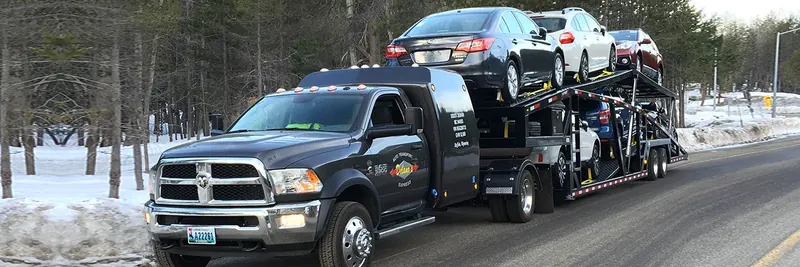
Illinois has a structural advantage in auto transport that has nothing to do with the state itself: almost everything crossing the country between the East Coast and the West passes through or near Chicago. That density of truck movement means loads assign quickly, rates are competitive, and there is usually a carrier heading roughly your way within a day or two.
What Illinois has working against it is five months of winter. From November through March, weather is the dominant scheduling variable on every lane in and out of the state, and it is the main reason a well-planned Illinois shipment includes buffer days.
The corridors that serve Illinois
Chicago is the single largest inland freight hub in North America, and the interstate network reflects it:
- I-80 crosses the northern part of the state, the main east–west transcontinental route linking the New York metro to California.
- I-90 runs from Chicago northwest toward Wisconsin and Seattle, and east toward Cleveland, Buffalo and Boston.
- I-55 runs southwest from Chicago through St. Louis toward Memphis, Jackson and New Orleans.
- I-57 heads south toward Memphis and the Gulf, and I-70 crosses the south of the state toward Indianapolis and Denver.
- I-94 connects Chicago to Detroit and, in the other direction, Milwaukee and Minneapolis.
- The practical effect is that Illinois connects to almost every region directly, so lanes out of Chicago rarely need a carrier to reposition to reach you.
Winter, and what it does to a schedule
The most important planning factor in the state for five months of the year:
- Snow and ice events routinely delay pickup and delivery by a day or more, and a major storm can stop regional movement entirely.
- Road salt is heavy across the state all winter. For a vehicle where that matters, enclosed transport is a reasonable choice in this specific window.
- Unploughed driveways and side streets are a common pickup problem. A loaded carrier will not attempt a snow-covered slope or an unploughed street.
- Batteries fail in sustained cold, and a vehicle that has sat outside through a Chicago January frequently will not start at pickup. Check before the driver arrives.
- Build buffer days into any fixed winter arrival date. A weather day is ordinary rather than exceptional.
- Book a wider pickup window in winter than you would in summer. It costs less and it absorbs a storm without a rebooking.
Chicago access
Not as constrained as New York, but harder than suburban Illinois:
- Downtown and the dense North Side neighborhoods have limited legal stopping for a 75-foot carrier, and a meeting point is common.
- Residential permit parking removes curb space in much of the city.
- Some low viaducts and underpasses restrict routing for a 13-foot-6 trailer, which affects how a driver reaches you.
- Suburban Cook, DuPage, Lake and Will counties are straightforward, with wide streets and room to work.
- Downstate Illinois — Springfield, Peoria, Champaign, Rockford — is easy loading throughout.
- In winter, street conditions matter more than street width. An unploughed street is not passable regardless of size.
Seasonal demand on Illinois lanes
Three patterns drive the calendar here:
- Snowbird southbound from October, with Illinois to Florida, Arizona and Texas among the busiest seasonal lanes out of the Midwest. Book four to six weeks ahead.
- Snowbird northbound from March through early May.
- College moves in mid-August and early May, given the concentration of universities in the state and the wider Midwest. See college student car shipping.
- Summer relocations from May through August, when lead times lengthen generally.
- Outside those windows, Illinois lanes are among the quickest in the country to dispatch.
What ships on Illinois lanes
A broad, ordinary mix, with two things worth calling out:
- Very high dealer and auction volume, with major auction activity around Chicago feeding national lanes. See dealer and auction transport.
- Agricultural and construction equipment across downstate Illinois. See heavy equipment transport.
- Snowbird vehicles in both directions on a strong seasonal cycle.
- Corporate relocations, given the concentration of employers in the Chicago metro. See corporate relocation car shipping.
- Ordinary daily drivers on open transport, which is the bulk of the volume.
Illinois metros we ship to and from
We collect and deliver anywhere in Illinois, not only in these metros. This is what is worth knowing about the busiest ones:
- Chicago. A national freight hub with excellent availability. City neighborhoods often need a meeting point; the suburbs are straightforward.
- Naperville, Schaumburg and the western suburbs. Easy suburban loading with very good carrier availability on the I-88 and I-290 corridors.
- Rockford. On I-90 northwest of Chicago, well served and easy to load.
- Peoria. Central Illinois off I-74, with reliable availability and easy access.
- Springfield. On I-55 between Chicago and St. Louis, directly on a major corridor.
- Champaign–Urbana. On I-57 and I-74, with a pronounced university calendar in August and May.
- Bloomington–Normal. At the junction of I-55 and I-74, easy loading and good availability.
- Metro East and the St. Louis side. Served by I-55, I-64 and I-70, effectively part of the St. Louis market.
Questions about Illinois car shipping
How does Chicago winter affect car shipping?
It is the main scheduling variable from November through March. Snow and ice delay pickup and delivery by a day or more, a major storm can stop regional movement entirely, and unploughed driveways and side streets are a common pickup problem. Book a wider pickup window in winter and build buffer days into any fixed arrival date.
Is Illinois a cheap state to ship from?
It is generally well priced, because Chicago is the largest inland freight hub in North America and carriers are already moving through it in every direction. Loads tend to assign quickly and a carrier rarely has to reposition far to reach you, both of which show up in the rate.
Can a carrier collect in the city of Chicago?
Often at a nearby meeting point rather than the exact address. Downtown and the denser North Side neighborhoods have limited legal stopping for a 75-foot carrier, and permit parking removes most curb space. The suburbs are straightforward, as is downstate Illinois.
Should I ship enclosed to avoid road salt?
In winter it is a more reasonable question here than in most states, because salt use is heavy across Illinois from November through March. For an ordinary daily driver it is not worth the difference. For a collector car, fresh paint or anything where corrosion is a real cost, it is a fair use of enclosed transport.
My car has been outside all winter and will not start. What now?
Tell us, because it changes the equipment and the price. A car that rolls, steers and brakes but will not start is loaded by winch, which is routine on a suitably equipped carrier. Dead batteries after a sustained Chicago cold snap are common and expected — an undisclosed non-runner at the curb is what causes problems.
Popular Illinois routes
Lane-specific detail on distance, transit, seasonal demand and pricing for the routes people ask about most:
Services on Illinois lanes
Open car transport
Snowbird and seasonal car shipping
Dealer and auction transport
Corporate relocation car shipping
States connected to Illinois
New York car shipping
East on I-90 and I-80.
Colorado car shipping
West on I-80 and I-76, or I-70 from southern Illinois.
Planning a Illinois move
How much does it cost to ship a car?
The price is set by the lane, not by miles alone: distance, direction, season and how many trucks are already going your way.
How long does car shipping take?
Pickup usually happens within a window of a few days of your first available date, often sooner on busy lanes.
Shipping somewhere else? See all states we cover, or popular routes.
Ready when you are
Send the route and we will price the actual lane.
A written quote, a vetted carrier and confirmed insurance. Nothing is charged until a driver is booked.