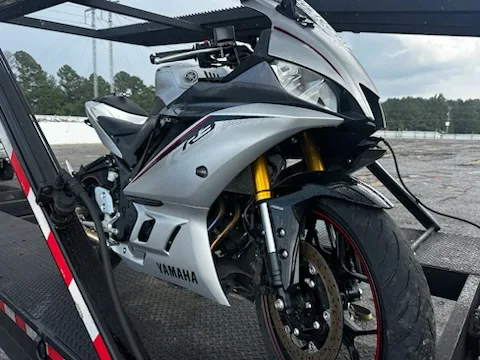
A motorcycle is not a small car, and shipping one on equipment designed for cars is where bikes get dropped. A bike has two contact points, no parking brake worth the name, and a center of gravity that moves the moment it leans. Securing one properly is a specific skill with specific equipment: a front wheel chock that holds the bike upright on its own, and soft straps to the frame rather than ratchets over the bars.
The good news is that this is a well-served corner of the industry. Dedicated motorcycle carriers exist, they run regular lanes, and they are usually cheaper than putting a bike on a car trailer.
The three ways a bike travels
Which one is right depends on the machine's value and how much of it is irreplaceable:
- Dedicated motorcycle carrier. A trailer built for bikes, with fixed chocks and tie-down points, often carrying six to twenty machines. The best value and the most common choice.
- Inside an enclosed car trailer. The bike shares the trailer with cars, chocked and strapped along one side. Suits a bike moving on the same lane as a car, or where enclosed is wanted without a crate.
- Crated. The machine is secured in a purpose-built crate, which is then handled as freight. The most protective and the most expensive, and the right answer for vintage, competition and concours machines.
- On an open car carrier is possible but rarely ideal, and only on carriers with proper chocks. We will tell you when a lane genuinely leaves no better option.
How a bike is secured properly
Worth knowing, because you can check it yourself at pickup:
- Front wheel in a chock that holds the bike upright without a person steadying it. If the driver is holding the bike up, the chock is wrong.
- Soft straps to the frame or triple clamps, not ratchet straps hooked over handlebars or levers.
- Suspension compressed, not bottomed. Some compression keeps the straps tight over bumps; fully bottomed for several days is hard on fork seals.
- Four straps minimum, two front and two rear, pulling in opposing directions.
- Nothing bearing on bodywork, exhausts or levers. Fairings and aftermarket exhausts are the most commonly damaged parts on a badly loaded bike.
- Ask for photographs of the bike as loaded. Reputable motorcycle carriers take them without being asked.
Preparing the bike
Fifteen minutes, and mostly common sense:
- Fuel to roughly a quarter tank, and check that the cap and any vent are sealed.
- Disconnect or tender the battery on anything travelling more than a couple of days.
- Remove the windshield, mirrors, saddlebags, top box, GPS and anything else that unclips.
- Fold or remove mirrors and, on tall machines, note the loaded height — screens and top boxes are what catch trailer ceilings.
- Photograph every panel, the tank, both wheels, the exhaust and any existing scratches, dated.
- Tell us the exact make, model and year, plus any non-standard width from panniers or crash bars.
What drives the price
Motorcycle rates move on different variables from cars:
- Distance and how well the lane is served by dedicated bike carriers. These trucks run fixed circuits, so being near one is worth more than being near an interstate.
- Transport type: dedicated carrier, enclosed trailer or crated, in ascending order of cost.
- Size and weight. A full-dress tourer takes noticeably more deck space than a sport bike and is priced accordingly.
- Whether the bike rolls. A non-running machine that still rolls and steers is straightforward; one that does not needs different handling.
- Timing. Rally season, auction dates and the spring riding season all tighten capacity on particular lanes.
Questions about motorcycle shipping
Do you ship motorcycles on car carriers?
Only where the carrier has proper wheel chocks and experience with bikes, and only when a dedicated motorcycle carrier is not a practical option on the lane. A dedicated bike carrier is usually both safer and cheaper, so it is what we look for first.
Does the motorcycle need to run?
It needs to roll and steer so it can be moved into the chock. A bike that rolls but does not start is routine. One that will not roll at all needs to be crated or handled with specialist equipment, so tell us which applies.
Should I crate my bike?
For a vintage, competition or concours machine, yes. Crating is the most protective option available and it is priced accordingly. For a modern road bike in regular use, a dedicated motorcycle carrier with proper chocks and soft ties is normally the sensible balance.
Can I leave gear in the panniers?
Remove the panniers and top box entirely, along with the gear. They add width and height, they are among the easiest parts to damage in transit, and their contents are not covered by the carrier's cargo insurance.
Related services
Where we ship
This service runs on every lane we cover. These are the states and routes people ask about most:
Before you book
How to prepare your car for transport
Wash the car and photograph every side, the roof and the wheels, with the date visible.
What documents do you need to ship a car?
For a domestic move from a home address, you usually need no title or registration paperwork at all, just the keys and someone to hand over the car.
Ready when you are
Send the route and we will price it properly.
A written quote, a vetted carrier and confirmed insurance. Nothing is charged until a driver is booked.