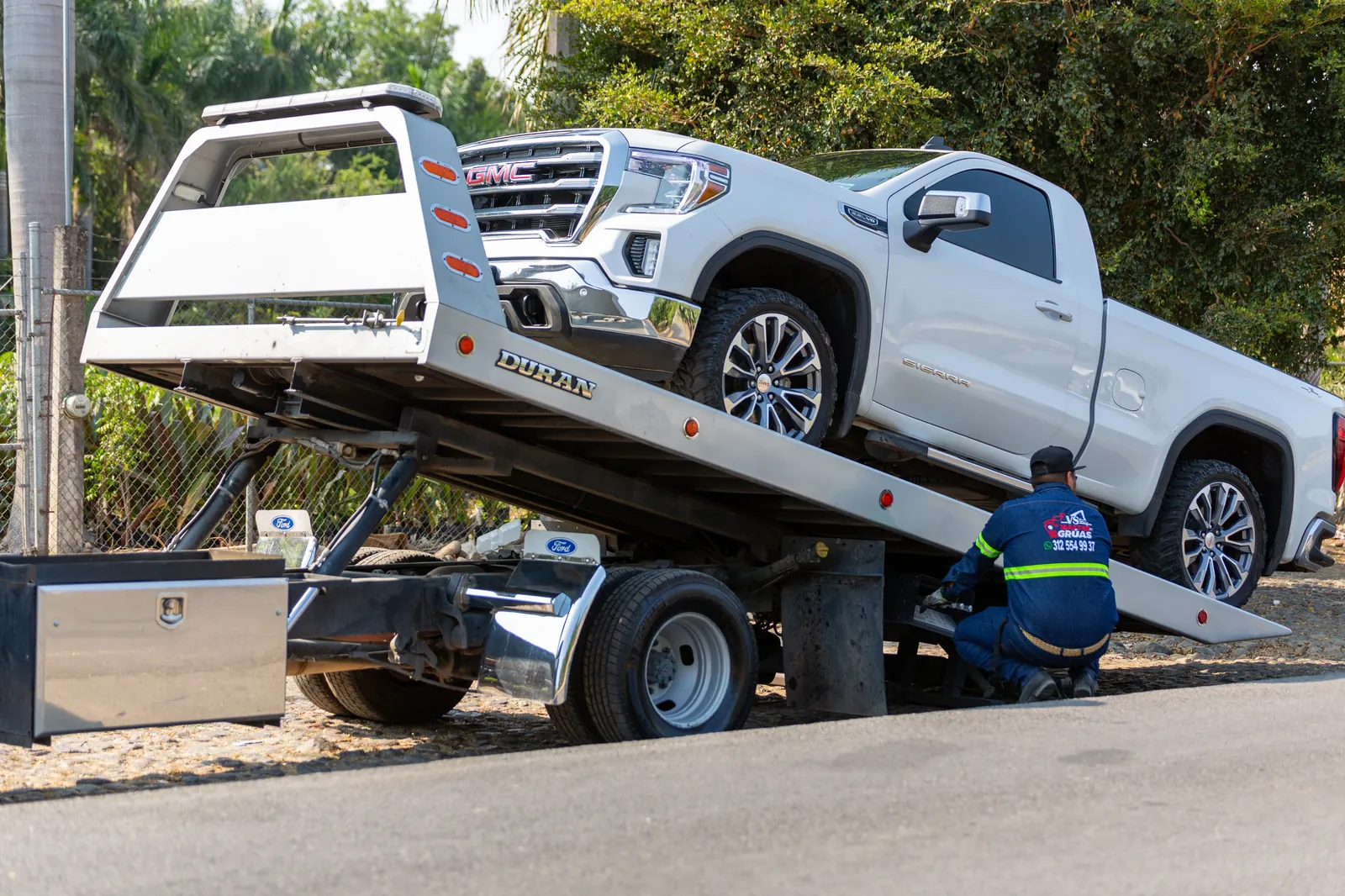
"Non-running" means four very different things in this industry, and getting it wrong is the most common cause of a refused load at the curb. A car that starts but will not shift is a straightforward winch job. A car with seized brakes and no steering needs a rollback or a forklift, and a carrier who arrives expecting the first will simply leave.
So the question we ask is not whether it runs. It is whether it starts, whether it rolls, whether it steers and whether it brakes. Answer those four honestly and the right equipment turns up the first time, at the price you were quoted.
The four questions that set the price
Answer each one for your vehicle before requesting a quote:
- Does it start and run? If yes, but it cannot be driven far, it may still load under its own power in ten feet.
- Does it roll? Wheels turn freely, no seized brakes, no flat-spotted or missing tires. This is the single biggest factor.
- Does it steer? The wheels turn with the wheel. A car that rolls but will not steer cannot be positioned on a trailer.
- Does it brake? Enough to stop it on a ramp or a gate. A car with no brakes needs to be controlled entirely by the winch.
- A vehicle that rolls, steers and brakes but does not start is the easy case and costs little more than a running car. One that does none of the four is specialist work.
The equipment each case needs
What we dispatch follows directly from your four answers:
- Winch-equipped open or enclosed carrier. Pulls the vehicle onto the deck. Needs the car to roll and steer. The most common and cheapest option.
- Rollback or flatbed tow truck. The whole deck tilts to the ground. Suits cars that roll but do not steer well, and short-distance moves.
- Forklift loading. For vehicles that do not roll at all. Needs a hard surface and room to maneuver at both ends, and is arranged in advance.
- Skates or dollies under the wheels. For seized brakes or missing wheels, on carriers equipped for it.
- Enclosed with a lift gate. Where the vehicle is both non-running and valuable, such as a restoration project or a collector car.
What it costs and why
Expect a premium over a running vehicle on the same lane. It is not arbitrary:
- Loading takes considerably longer, and the driver's time is the scarcest thing in this industry.
- The pool of suitable carriers is smaller, because not every trailer has a working winch.
- Position on the trailer is constrained; a non-runner usually has to load last and unload first, which limits what else the driver can carry.
- Vehicles that do not roll need equipment that is scarcer again, and sometimes a second person on site.
- Being accurate about the four functions is what keeps the quote honest. An unexpected non-runner at the curb means a refused load, a repositioning fee, or both.
Preparing a vehicle that does not run
More preparation than a running car, and most of it is about access:
- Make sure there is clear, straight space in front of the vehicle for a winch line and a flat approach. A car in a tight garage or behind other vehicles cannot be reached.
- Confirm the surface is hard and level at both ends. Winching a dead car across grass or gravel frequently fails.
- Check that a tow hook or recovery point is fitted and accessible, and tell us if there is not one.
- Make sure the steering is unlocked and the key is available, even if the car will not start.
- Fit or inflate tires if you can. A car on four inflated tires is dramatically easier and cheaper to load than one on a flat.
- Photograph everything, including the existing damage that made it a non-runner, and note it on the Bill of Lading before pickup.
Questions about inoperable vehicle transport
What counts as inoperable?
Any vehicle that cannot be driven onto the trailer under its own power. That covers everything from a car with a flat battery to one with no engine. What matters for pricing and equipment is whether it rolls, steers and brakes, so answer those three separately rather than just saying it does not run.
How much more does it cost?
Enough to cover substantially longer loading, a smaller pool of suitable carriers and a constrained position on the trailer. A car that rolls, steers and brakes but will not start is only modestly more than a running vehicle. One that does none of those is a different job with different equipment and is priced as such.
Can you collect from a body shop or impound lot?
Yes, and it is routine, but arrange release authorization and access hours in advance. Lots will not release a vehicle to a carrier without paperwork, and the carrier cannot resolve that on your behalf at the gate. Storage fees are yours to settle before collection.
What if I say it runs and it does not?
The driver arrives with a trailer that cannot load it, and the load is refused at the curb. You may be charged a dry-run or repositioning fee and the vehicle waits for a rebooking. It costs nothing to be accurate at quote stage and quite a lot not to be.
Related services
Open car transport
Classic and antique car transport
Heavy equipment transport
Dealer and auction transport
Where we ship
This service runs on every lane we cover. These are the states and routes people ask about most:
Before you book
Ready when you are
Send the route and we will price it properly.
A written quote, a vetted carrier and confirmed insurance. Nothing is charged until a driver is booked.