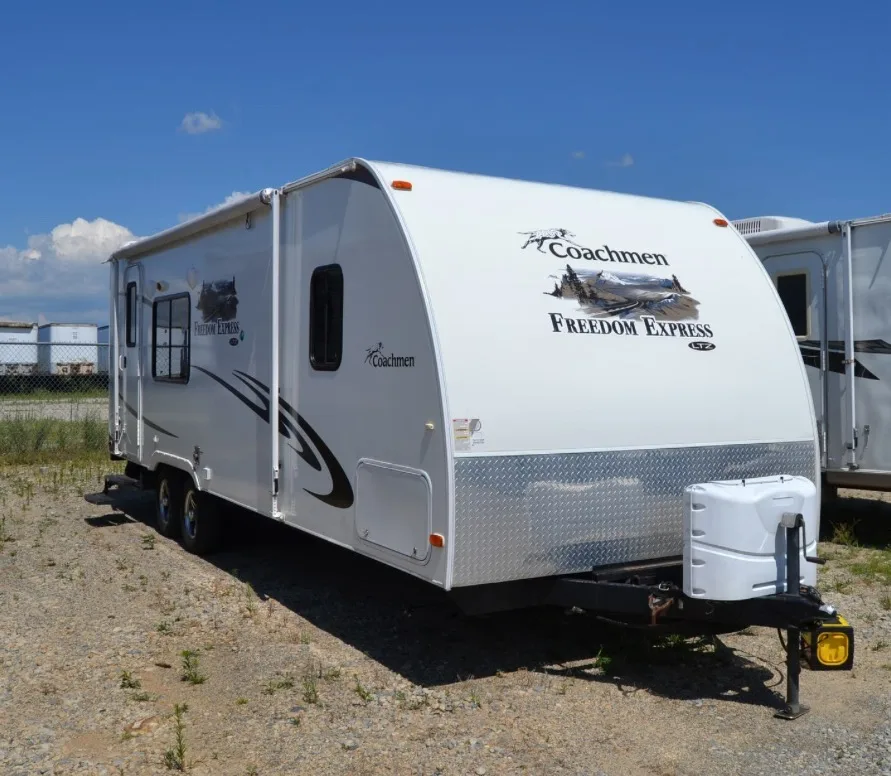
There are two quite different jobs here, and the price difference between them is large. A travel trailer or fifth wheel is towed by a carrier with the right hitch. A motorhome drives, so it is usually moved by a qualified driver behind the wheel rather than on a trailer, because almost nothing can carry a Class A.
Both are priced on dimensions, weight and condition rather than on a model name. Most RVs are over 8 feet wide and many are close to the 13 foot 6 inch height ceiling, which puts them into permit territory on some or all of the route.
Towed transport for trailers and fifth wheels
The equipment is straightforward; the roadworthiness is what decides whether the move happens on the day:
- Travel trailers and fifth wheels are towed by a carrier with the correct hitch, gooseneck or fifth-wheel plate.
- Tires are the most common failure. RV tires age out long before they wear out, and a carrier will refuse a trailer on cracked or out-of-date tires rather than risk a blowout at highway speed.
- Bearings, brakes and lights must all work. If the trailer has sat for a season, have them checked before booking.
- Current registration where your state requires it for the trailer itself.
- On a flatbed instead if the trailer is not roadworthy, which costs substantially more and needs the dimensions and weight confirmed.
Drive-away for motorhomes
A qualified driver collects the motorhome and drives it to the destination:
- The vehicle must be fully roadworthy and legally operable, with current registration and valid insurance in force for the trip.
- Mileage accrues. This is the trade-off people are most often surprised by: the odometer reflects the whole journey.
- It is normally the cheapest option for a Class A, because nothing on the road can carry one economically.
- Confirm your insurance covers a driver who is not you. Your insurer will confirm it in one call, and we will need evidence.
- Fuel and tolls are normally billed to you; confirm what is included before booking.
- Towed transport on a trailer is possible for smaller Class B and Class C motorhomes, at a higher price and without the mileage.
Dimensions, permits and access
The same thresholds as any oversize load, and most RVs cross at least one of them:
- Measure width at the widest point, including awnings, slide-out mechanisms and mirrors, as it will travel.
- Measure height from the ground to the top of the air conditioner, satellite dome or vent — not to the roofline.
- Over 8 feet 6 inches wide requires permits in every state crossed; we apply for them as part of the booking.
- Over 13 feet 6 inches tall restricts the route, adds mileage and can add days.
- Access matters more than for a car: a tractor unit plus a 40-foot trailer needs a hard surface and a wide turning circle at both ends. Storage yards and campgrounds are frequently the tightest point on the whole route.
Preparing the RV
An RV is a house that is about to be driven at 65 mph, and it needs packing as one:
- Retract all slide-outs and awnings, and lock them.
- Drain fresh, gray and black water tanks completely. Water is heavy and it moves.
- Turn off and disconnect propane at the tank, and confirm the requirement with the carrier; many will not move a trailer with propane connected.
- Secure every cupboard, drawer, door and the refrigerator, and remove anything loose from countertops.
- Remove or secure roof-mounted items, and photograph the roof — it is the part nobody inspects and the most common site of a surprise on delivery.
- Disconnect or tender the house and chassis batteries.
- Photograph all four sides, the roof and the underside of the rear overhang, dated.
Questions about rV and motorhome transport
Is drive-away or towed transport better for a motorhome?
For a Class A, drive-away is usually the only economical option, because almost nothing on the road can carry one. The trade-off is that mileage accrues on the odometer. Smaller Class B and Class C motorhomes can sometimes be towed or trailered instead, at a higher price and without the mileage.
Will my RV tires be a problem?
They are the single most common reason a booked RV move does not happen. RV tires age out long before the tread wears down, and a carrier will refuse a trailer on cracked or out-of-date tires rather than risk a highway blowout. Have them checked before you book, especially after a season in storage.
Do I need permits for my RV?
Over 8 feet 6 inches wide, yes, in every state the move crosses, and most RVs are wider than that. We apply for them as part of the booking. Allow several business days of lead time on a multi-state oversize move.
Can I leave my belongings inside?
Keep it light and secure everything. Weight affects the quote and can push the load into a different permit tier, contents are not covered by the carrier's cargo insurance, and anything not secured will move for several hundred miles. Drain all water tanks completely before pickup.
Related services
Heavy equipment transport
Boat transport
Snowbird and seasonal car shipping
Free car shipping photos
Where we ship
This service runs on every lane we cover. These are the states and routes people ask about most:
Before you book
Can you ship personal items in your car?
Carriers generally accept up to about 100 pounds, in the trunk or rear cargo area below the window line, if the driver agrees at pickup.
How to prepare your car for transport
Wash the car and photograph every side, the roof and the wheels, with the date visible.
Ready when you are
Send the route and we will price it properly.
A written quote, a vetted carrier and confirmed insurance. Nothing is charged until a driver is booked.